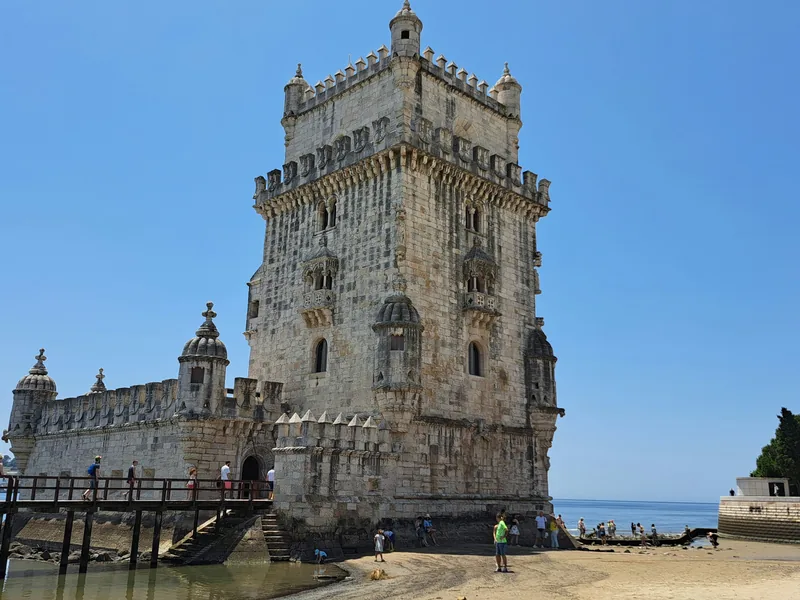
Torre de Belém is one of the most photographed monuments in Portugal — a four-storey Manueline limestone tower built 1514-1519 by architect Francisco de Arruda, commissioned by King Manuel I as a fortified gateway protecting the mouth of the Tagus and a symbol of Portugal's emerging maritime empire. From this stretch of river, Vasco da Gama set out for India in 1497 and returned in 1499; Pedro Álvares Cabral departed for Brazil in 1500; Bartolomeu Dias rounded the Cape of Good Hope. The tower watched all of it.
Four storeys plus the terrace. The bastion (rondela) at water level held the cannon battery. The governor's hall, royal hall, and audience chamber are stacked above, each with armillary spheres, Crosses of Christ, and rope-stone Manueline carvings on the window frames. The chapel is tucked into the third floor. The terrace gives one of the best views in Lisbon: the Padrão dos Descobrimentos monument 500m away, the 25 de Abril Bridge, and the Cristo Rei statue on the south bank. Plan 45-60 minutes inside.
Belém Tower and Mosteiro dos Jerónimos were inscribed by UNESCO in 1983 as a single joint World Heritage Site — they are historically inseparable. Both commissioned by Manuel I from the same wealth that flowed in from the maritime expeditions. Both completed in the early 1500s. Both designed in the Manueline style that exists nowhere else. They are 10 minutes' walk apart. Visit them on the same morning and you have the most complete day in Portuguese imperial history available anywhere.